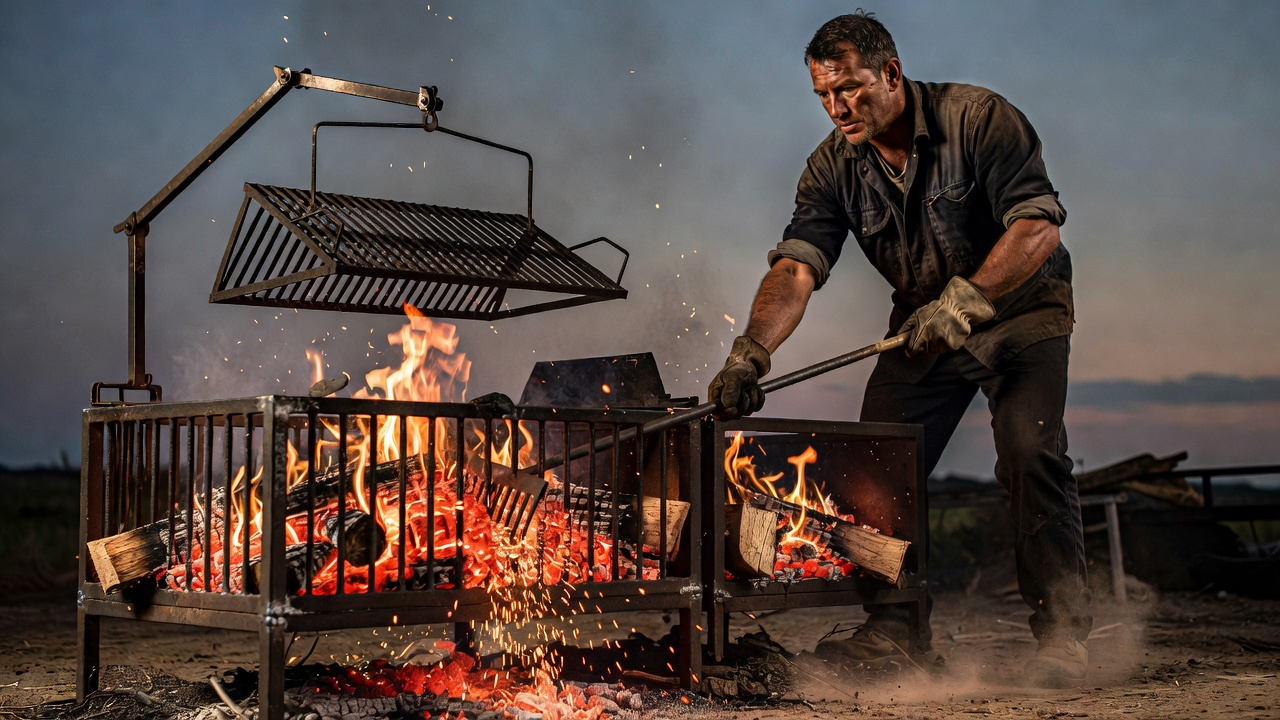
 Burn Box & Bed
Three Thermal Regimes in One Hearth
When a dining room commits to open-fire cooking without gas backup, the kitchen must solve a fundamental physics problem: wood burns unevenly. Freshly split logs flare violently with volatile gases, surge in temperature, and throw soot. Half an hour later, once moisture and bark volatiles have burned off, the remaining carbon bed radiates steady infrared energy with almost no visible smoke.
Across the Mediterranean, specialized fire kitchens handle that cycle through spatial separation. In Catalonia and Valencia, cooks maintain a raised steel cradle called a brasero—a dedicated burn box on one side of the hearth where holm oak, olive prunings, or almond wood ignite freely. As bright coals drop through the iron slats, a long shovel transfers pure glowing fuel under the working grates. In Levantine mangal setups, charcoal is pre-lit in an adjacent chimney pit and fed into narrow troughs so skewers never encounter raw, resinous flame.
Live Flame Zone
Bright orange-yellow combustion fed by vine cuttings (sarments) or split pine. Used for blistering whole calçot onions, flash-heating thin paella pans, and lighting the fuel cage.
Radiant Ember Bed
White-ash hardwood coals emitting dry infrared energy. Powers adjustable V-channel grills, hinged fish baskets, and narrow mangal skewers.
Retained Masonry
Refractory brick, volcanic tuff, or fired clay domes such as the Neapolitan forno a legna and Levantine taboon. Combines conductive floor heat with dome radiation.
Radiant Coals: V-Channel Grates, Planchas & Skewers
The geometry of metal above embers alters flavor as profoundly as wood species. Round steel bars allow rendered fat to drip straight onto hot coals, sending brief plumes of vaporized lipids back onto meat—classic for lamb ribs or spiced kofta on a mangal. Yet dripping fat on delicate seafood or high-oil mackerel causes acrid flare-ups.
Many Iberian and Italian coastal hearths counter this with slanted V-shaped iron channels popularized across Basque-influenced asadores and adapted along the Mediterranean littoral. As fish skin or marbled cutlets warm, excess oil runs down the angled troughs into a drip tray rather than exploding into smoke on the coals. Other kitchens lay thick cast-iron plancha plates or terracotta tiles atop the grate, marrying conductive browning with wood-fired ambient heat.
Where skewers dominate—as in southern Turkey, Lebanon, and Málaga—metal mass acts as an internal conductor. Flat, wide steel blades used for adana or kofta transmit heat straight into the center of minced lamb so the exterior chars at the exact moment the core turns juicy. Conversely, Málaga’s beachside espetos rely on dry cane reeds stuck into sand beside olive-wood coals, keeping the sardine skin tight while the cane slowly chars from the outside.
Domed Clay & Stone: Taboon, Tannour and Forno
Not every fire dish looks at open coals. Across North Africa, the Levant, Greece, and southern Italy, enclosed clay ovens harness three simultaneous heat transfers: conduction from the baking floor, convection from circulating air currents, and radiant reflection off a curved ceiling.
In the Levantine taboon, traditionally set half into the earth and banked with embers outside its clay shell, the interior floor is carpeted with smooth river pebbles (radaf). Flat dough pressed over those heated stones bakes unevenly into blistered valleys and crisp domes, trapping pockets of steam inside. The cylindrical tannour—cousin to the Central Asian tandoor—takes the opposite posture: a vertical clay sleeve lined with hot charcoal at its base, where bakers slap stretched discs directly onto the curved inner wall.
Meanwhile, in Campania and Sicily, the low-slung brick forno a legna keeps a live oak or beechwood fire sweeping across the vaulted dome. At 450°C, a pizza dough with zero added sugar blisters in under ninety seconds without drying its tomato passata. Hours later, after service ends and coals subside to 190°C, that same sleeping oven braises terracotta pots of beans, fennel, and octopus overnight—echoing the sealed clay gastrin and kleftiko traditions of the Aegean.
Burial in White Ash & Earth Pits
The quietest Mediterranean fire method requires no grate or oven at all: direct ash burial. When dense olive or oak wood reduces completely to fine grey-white ash, residual embers underneath hold steady heat around 220°C while the ash blanket insulates food from oxygen. No oxygen means zero scorching flame.
Whole celeriac, beets, baby artichokes, leeks, and foil-free salt-crusted sea bream slip straight into the ash bed. Skin dehydrates into an impermeable shell while interior moisture gently poaches the flesh. In Morocco’s Atlas foothills and rural Sardinia, that same principle scales upward into the earth pit—mechoui or Sardinian su porcheddu roasted beside buried wood coals and aromatic myrtle branches—proving that Mediterranean firecraft values patience just as highly as speed.